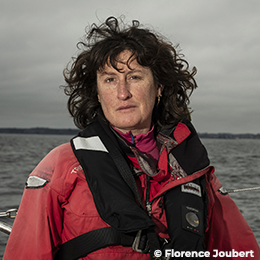
Laura TROUDET

Co-founder and director of Skravik Sail fishing and scientific charter

Sail fishing and scientific charter

Since the beginning of the project, Skravik has benefited from the support and funding provided by France Active, which has helped to ensure its successful launch. This support has been crucial in enabling us to reach several key milestones, notably the acquisition of a second vessel, which is essential for the expansion of our fleet.

Skravik: decarbonising the seas by sailing from Brest harbour

Plougastel-Daoulas (29)
Sail fishing and scientific charter

At the age of 37, Laura Troudet – a coastal oceanographer turned cooperative seafarer – co-founded Skravik, a maritime cooperative based in the harbour of Brest. Established in 2017 as an association, transformed into a SCIC in 2024, the organisation uses working sailing vessels to reinvent small-scale fishing and marine research, with a focus on sustainability and public interest.

The journey of a committed entrepreneur

After an initial career in scientific research, working on the Brittany coastline at the CNRS and Ifremer, Laura Troudet felt the need to get involved in a more hands-on project. She therefore chose the path of collective entrepreneurship, co-founding Skravik with the ambition of bringing about tangible change in maritime practices. Through this career change, she has put her skills as an oceanographer to use in a project combining ecological transition, social innovation and a deep connection to a region strongly shaped by maritime industries.

A public-interest maritime cooperative

Based in Plougastel-Daoulas, in the Bay of Brest, Skravik describes itself as a private company serving the public interest, with strong local roots and deeply embedded in Breton maritime traditions. All employees are seafarers, which reinforces the coherence of the project and the cooperative’s legitimacy in the eyes of industry stakeholders. In 2024, the transition to a SCIC has allowed to structure a more open governance structure by involving several new stakeholders – seafarers, research partners and local supporters – as shareholders, well reflecting the original spirit of the project.

Working sailing vessels for fishing and science

Skravik currently operates two working sailing vessels, designed to sail in Brittany – from the Bay of Brest to the Iroise Sea and beyond – and to meet a variety of needs. The sailing vessel SKRAVIK carries out low-impact, small-scale coastal fishing, with sales through short supply chains. The cooperative also undertakes scientific missions of short or long duration, aboard the MORSKOUL, for oceanographic research, with the crew handling logistics and providing technical support to the researchers. This hybrid approach allows the cooperative to maintain its roots in the fishing industry whilst making a direct contribution to our understanding of the marine environment.

A sustainable maritime transition, beyond technology

The cooperative has an ambitious vision for decarbonising the maritime sector, which goes beyond simply replacing one engine with another. For Skravik, the transition begins with reducing the role of the engine, prioritising sailing, and revitalising maritime professions.

This approach takes a thorough look at the organisation of work at sea, fishing schedules, distances travelled and the associated business models. It forms part of a wider movement towards sustainable maritime practices that can help preserve both fish stocks and the resilience of coastal areas.

“Light science” at sea: a new framework

Alongside its fishing activities, Skravik is developing a framework for “light science” at sea, tailored to ship-based campaigns that require fewer resources in terms of energy and equipment. This methodological framework, developed in collaboration with the cooperative’s teams, is now recognised by the French Oceanographic Fleet operated by Ifremer. In 2024, this recognition has been formalized with the launch of Avel Lab, a strategic partnership that positions Skravik as a full-scale laboratory for new at-sea research practices.

A diversified and resilient business model

Skravik’s business model is based on several complementary pillars: scientific services provided to laboratories and institutions, income from coastal fishing through direct sales, and support from organisations in the social and solidarity economy. This mix of activities helps to mitigate the uncertainties associated with both the seafood markets and the schedule of scientific campaigns. It also enables the cooperative to invest, to professionalise its operations and to secure long-term employment for seafarers.

The role of France Active

“Since the beginning of the project, Skravik has benefited from the support and funding provided by France Active, which has helped to ensure its successful launch. This support has been crucial in enabling us to reach several key milestones, notably the acquisition of a second vessel, which is essential for the development of the fleet,” explains Laure Troudet. France Active has also supported the organisation’s transition to a cooperative model, providing expertise on financial arrangements and facilitating dialogue with partners in the social and solidarity economy and the local area.

Training the next generation of seafarers

Beyond its fishing and research support activities, Skravik has set itself a strong educational mission: to help train the next generation of seafarers by immersing them in a cooperative environment where technical autonomy goes hand in hand with collective values. On board, learning takes place in conditions as close to reality as possible, encompassing sailing manoeuvres, a detailed understanding of marine ecosystems and the sharing of a culture of teamwork. This educational aspect aims to inspire vocations and demonstrate that a different approach to maritime work is possible.

Collective achievements and a vision for expansion

Among her proudest achievements, Laura Troudet highlights the Avel Lab partnership, secured after several years of efforts and administrative hurdles, which has established the project’s legitimacy among the research community. She also emphasises the vitality of the cooperative community, made up of people from diverse backgrounds united by a shared commitment to environmental and social standards. Looking ahead, Skravik’s vision is not to expand at any cost, but to spread the word: to help other regions develop sustainable and resilient sailing fleets, rather than becoming a “green multinational”.

Has benefited

from a guarantee of

67 500€

from an investment of

135 000€

Was supported by

France Active Bretagne

It's here !

Others stories

Partager sur...
Share on FacebookTweet about this on TwitterShare on LinkedInEmail this to someonePrint this page