
A cooperative production company


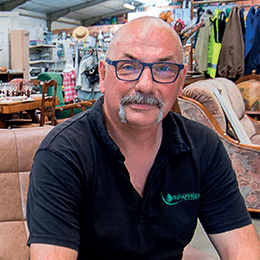
Paul CLÉMENT
President of Tripapyrus
Waste collection and recycling
Tripapyrus was founded in 1994 as an association, then transformed into a cooperative production company in 2014. Paul Clément has been the president since 2014, and he has been supporting the transformation of the company’s activities, particularly in terms of handling and processing plastic waste.

85220 Aiguillon-sur-Vie
Waste collection and recycling
Waste management is evolving, and so is the project
Initially there was the Papyrus association, whose purpose was to collect paper before it ended up in the bin and then to sort it. This activity, carried out by local communities, had a social objective, as it supported unemployed people to get back into the work environment, and an environmental objective with the preservation of forests and the fight against waste. By the end of the 90s, the sector was shifting. Selective sorting of waste had become institutionalized, as had the programmes for getting people back into work. Renamed TRIPAPYRUS, the structure adapted to this new dynamic, became more professional and became a company to operate a packaging sorting centre in Givrand for 15 years.
History moves fast, because just a few years later, the optimisation of these sorting centres led to the creation of mega-sorting centres. The one managed by Papyrus had become obsolete and required a reorganization. “Our activity related to the sorting centre stopped completely in 2016, the flows were sent elsewhere. That represented 70% of our turnover, and just as high a percentage of our employees. We were able to find new roles for everyone, but we had to bounce back. Of course, we were out of “petrol”, but we had plenty of ideas for what to do next. The cooperative production company, created in 2014, allowed us to develop with motivated staff, collectively involved in the project. This model was consistent with our approach and is reflected in our resilience,” says Clément.
Transformation and support
The structure created a recycling centre in 2017, called “RECYCLER LA VIE” (recycle life) which also incorporated a social project. At the same time, an industrial subsidiary was created whose activity consists in refining plastic waste, previously collected by TRIPAPYRUS, and preparing it for recycling. The idea is to turn plastic from waste into a product.
A successful transformation with the support of France Active. “ In 2016, we found ourselves in a really tight spot after the loss of jobs and our business. We started working with France Active whose support really helped us to bounce back. The two ancillary units, the recycling plant and the plastic refining centre, were created. We’ve worked on our new model to get back on the ground. A refinancing plan has been drawn up to support our development. I am very pleased: Beyond funding, there is support that really helps us on a daily basis. By understanding who we are, how we act and where we want to go, the way forward is much clearer. This support is carried out in partnership with the collective production company network. It is very important to have solidarity-based funding from partners who go where others don’t. ”
Local business first and foremost
After transforming its business, maintaining and diversifying its social commitment, TRIPAPYRUS wants to go further. “Our goal is that the recycled plastic is used as something that will last a long time, i.e. that it is transformed into a sustainable object .” In addition to this, there is the desire to be firmly rooted in the local region: ” The project is also about wanting to live in the west of the Vendée region. This desire defines our development strategy on the basis of the region’s characteristics“.
Industrialize commitment
The health crisis has massively boosted awareness, and the TRIPAPYRUS model attracts increasing interest, until finally the company was contacted by Airbus for their expertise on plastic recycling. “We have several examples of this kind. Awareness is increasing across the economy as a whole, and I don’t think it is just for 5 minutes. People are changing their attitudes and discovering what a small structure can do, understanding the potential of our models for new ways of producing”. And for Paul Clément, the energy generated by collective companies of this kind has a future. “There is a real know-how in the circular economy that polarizes attention. We are active in the waste sector, but all areas of solidarity economy are affected . People come to seek our solutions, we must be up to the task.”
Has benefited
from a solidarity loan of
€75,000
from a solidarity investment of
€75,000
Was supported by
France Active Investissement
and
France Active Pays de la Loire
In 2008
In 2013
In 2018
In 2019
It’s here !

Others stories

[related_post_fa posts_per_page="15" post_type="post" post_category="stories"]
All stories
The Creation Pact to facilitate business creation

Helping entrepreneur make their projects feasible & secure by financing start-up
Because we are convinced that business creation is not only for those who graduate from great school and for those who benefit from the support of their relatives, France Active has decided to reinforce its action of support & financing of business creation for those who are the most distant from it.
Today, France Active announce the reinforcement of its Creation Pact for people in professional integration situations. It is particularly aimed at young people, those without jobs or training, those from disadvantage districts or even those who come from isolated rural areas, in the context of the call for proposals initiated by the Ministry of Labour, Employment & Integration. The reinforcement of the Creation Pact also aims to provide increased support to those who encounter difficulties in the creation of their structure. Any person with a business creation project or any person for whom such a project may be a good solution to achieve a professional project, can pretend to:
- Financing solutions & guarantee from France Active;
- A Creation Pact strengthened on 3 axes: Financial pedagogy, protection & securing and digital awareness;
- A €3 000 financial aid to facilitate the start-up of their project (if all the eligibility conditions are met).
This reinforced support towards entrepreneurs has been possible thanks to the Inclusion through self-employment’s call for proposals by the Ministry of Labour, Employment & Integration. France Active and its 35 regional associations will support until the end of December 2022, 4 000 entrepreneurs in their creation stage.

Others news

[bloc_ajax]
All News
Social finance week from November 8th to 15th

Since 2008, the Social Finance Week takes place each year in November, aka the Social Economy Month in France. It aims at raising public awareness about social finance though various events all over France. The 14th edition will be held from November 8th to 15th. As the last French Social Finance Barometer published by FAIR (former Finansol) shows, this initiative is becoming increasingly important.
Sponsored by the daily newspaper Le Monde as well as by FAIR, the “Grands Prix de la finance solidaire” will be awarded during this week. The prizes will be granted to social enterprises that have been supported by social finance. The prizewinners will be announced during the award ceremony on November 9th at the City Hall of Lyon.
Social finance, and more specifically solidarity-based finance as we call it in France, supports various social or environmental ventures with citizen’s savings. Savings are invested partially or totally in activities like job creation for people who have been out of work for some time, housing very low-income families, energy-saving devices or business start-ups in developing countries. Asset management companies collect solidarity-based savings and invest them in social investment companies. France Active Investissement thus mobilizes those savings to finance social enterprises, at every stage of their company’s life (seed stage, development, recovery, etc.). With 254,8 million euros in capital at the end of 2020, France Active Investissement invested in 2020 more than 22 million euros in 338 social enterprises.
Others news
[bloc_ajax]
All News
Increasing Solidarity in Europe – Nicolas Schmit, European commissioner for Jobs and Social Rights

The European Commission is preparing an Action Plan to implement the European Pillar of Social Rights. After the crisis, is it still urgent to accelerate social reforms?
The emergency already existed before the crisis. Over the past decade, some flattering economic indicators have masked a rise of inequality – these issues were inherited from the previous crisis. The new European Commission then placed digital and green transformation at the center of its priorities. While this digital and green transition creates jobs, it requires a considerable effort in professional training, especially in new technologies. The COVID-19 crisis has accelerated these pre-existing trends. In the short term, the projections are alarming for the climate if we do not drastically reduce emissions of carbon dioxide (CO2). The challenges are colossal, the development of skills is crucial if we want to avoid massive and structural unemployment. The situation also amplifies inequalities and the risks of poverty. There is therefore a legitimate expectation to rebuild with more social justice. The young generations are the first victims of this crisis in terms of employment, education but also social life. Not only there is a risk of producing a new lost generation but also a desperate one.
The European Pillar of Social Rights Action Plan must set the course to avoid a real social crisis. Investment must create new jobs through digital and green technologies. There is a need for mobilization at all levels and social economy actors should play an important role.
How does this Action Plan concern the Social Economy (SE) world?
SE enterprises are pursuing the same objectives as the Action Plan to implement the Pillar, including social cohesion, the creation of quality jobs, sustainable development, the struggle against social inequalities and the protection of the most vulnerable. The economy and society must be reconciled, which means, as President Ursula von der Leyen said, “an economy that works for people”.
The Action Plan includes an initiative in favor of the SE. These enterprises that have been often hard-hit by the crisis and must therefore be supported, will contribute to the economic recovery and its inclusiveness. We propose to strengthen the resilience of the sector, by helping its professionalization, its development, its visibility and by improving its access to financing and access to market.
You recently said that it was time “to have a reflection on the social value of work”. How can we transform the models in Europe?
The question of the value and dignity of work has been raised for a long time already. Precariousness is spreading and affects in particular the youth. The pandemic taught us that women often occupy jobs that are essential for the functioning of society. Yet, they are less paid and their working conditions are often difficult. They need to be revalued. More broadly, we need more social convergence in Europe.
The European Commission’s proposal on minimum wages aims to raise low wages in Europe and to reduce the increase in numbers of working poor, among other things. The end of the crisis should be the time to rebuild a new social contract. This Action Plan must include very concrete solutions while redesigning the European social model where economic success goes hand in hand with social and ecological progress
Others news
[bloc_ajax]
All News
Transform to look beyond the crisis

Yannick VALIN
General Secretary of Transe Express and co-director of the Gare à coulisses
Culture and art
The health crisis has served to strengthen our beliefs and forced us to make a choice: To keep our vision and momentum, rather than suffer.
26400 EURRE (Auvergne Rhône Alpes)
Culture and art
Live show
Street art shows bringing together dozens of musicians and circus artists, large-format air-based shows that can be performed in front of 15,000 spectators around the world… this has been the artistic project of the Drôme-based company Transe Express for almost 40 years. Not to mention the Gare à Coulisses, which it created in 2007 in the heart of the region’s organic Biovallée area to support the emergence of street and dancefloor art and which was recognised as an “Atelier de Fabrique artistique” in 2017. ” With our two activities, our association brings together nearly 35 trades and up to 150 intermittent performances,” explains Valin. “It’s a real hive of activity that never stops and represents all the stages of artistic creation – from conception of a project to presenting it to audiences. “
Opening up for the future
March 2020: This dynamic came to an abrupt stop as a result of the health crisis. In total, the company lost 95% of its distribution. “Our first reaction was, of course, just astonishment”. But that didn’t take into account the dynamic of transformation that had already been at work within this collective for a year and a half. Indeed, when Yannick Valin arrived on the scene in April 2019, the company was at a turning point in its history with the departure a few years earlier of the two founders, Brigitte Burdin and Gilles Rhode. “To survive, we had no option but to evolve with the times”. And this is what he is working on with the rest of the team. They are working on issues relating to ecological transition and cultural rights. They also plan to diversify their activities (with a restaurant in particular) and start to redesign the construction workshop at the Gare à Coulisses. They want to make it a true third place to train job seekers in eco-construction practices, and then to meet the needs of local businesses in a virtuous regional loop.
Levers of action to see further
Different types of support are on offer to assist in this transformation. First of all, a local accompaniment device (DLA) with the Ardèche branch of France Active, Initiactive 26 07, to redefine the economic model of the structure. “Initially, it is never easy to opt for complete openness and to accept someone coming to question accounts. But this DLA has been very positive. In fact, it allowed us to approach 2021 with 4 different scenarios of how to come through the current crisis (from the most optimistic to the most pessimistic). It was essential to be able to count on the support of Initiactive 26 07 at that time”. In
parallel, the association’s social and environmental responsibility (CSR) programme has also been introduced to work on its governance, its accessibility within the region and its local impact on topics such as education, employment, food, energy, etc. Luc Carton, a Belgian philosopher specializing in cultural rights, was also asked to assist with the transition between the current project and the one in line with the label acquired in the summer of 2020, “Scène conventionnée d’intérêt national Art en Territoire”.
“So it was thanks to these three forms of support, initiated before the crisis, that we were able to move very quickly beyond this first phase of taking stock. It took us 15 days to recover and to say to ourselves that instead of shutting everything down, we had to do the opposite: Continue to invest in our future. That is why we didn’t make any redundances, and resorted to partial unemployment only very minimally, and why we reclassified 4 positions as permanent employment. We have kept all the strength of our collective to continue working on our key project.”
The association contracts in parallel a loan guaranteed by the State as well as a France Active solidarity loan for a total amount of €100 000. This is a sum that the association decided not to use immediately, but rather to keep it for future use “ to drive momentum, always in this logic of investing in the future.”
Web site
Have benefited
from several guarantees of
€20,000
A solidarity loan of
€100,000
A investment of
€60,000
A DLA
Were supported by
France Active in Ardèche (Initiactive 26-07)
And supported by
Daniel & Nina Carasso Foundation
In 2020
It’s here !
Others stories

[bloc_ajax params="{count:7,ess:0}"]
More stories
The UrgencESS fund, which has helped nearly 5,000 small associations to cope with the crisis, has reached its target

In January 2021, Olivia Grégoire, Secretary of State to the Minister of the Economy, Finance and Recovery, in charge of the Social, Solidarity and Responsible Economy, mobilized an emergency fund of 30 million euros for social and solidarity economy (SSE) structures with fewer than 10 employees, hit by the crisis. This financial aid, ranging from 5,000 euros for structures with 1 to 3 employees to 8,000 euros for structures with 4 to 10 employees, has helped 4,866 structures experiencing economic difficulties related to the current turmoil, most of which are associations. The impact on job preservation is concrete: thanks to this support, nearly 16,000 jobs have been saved. Deployed by France Active and its 35 associations, UrgencESS has made it possible, in addition to financial aid, to support solidarity structures in maintaining their activity. They benefited from a diagnosis of their economic situation and received advice to help them find new financing solutions, notably thanks to the measures deployed within the framework of France Relance.Some of them also received support from the operation’s partners, such as the network of Local Support Facilities (DLA) or KissKissBankBank, the pioneer of participatory financing which belongs to the La Poste Group.

Olivia Grégoire
Secretary of State for the Social, Solidarity and Responsible Economy
The structures that we have been able to support through the crisis are better equipped to engage in the recovery, which concerns all economic actors in the country. We must now continue our policy of supporting SSE companies by developing new sustainable financing compatible with the solidarity dimension they carry on a daily basis.

Pierre-René Lemas
President of France Active
With UrgencESS, we have been able to provide a more than tangible response to associations as well as to companies fully mobilized on the development of social ties, culture or ecology. And we have also enabled them to think about their model for rebounding from the crisis and to project themselves into a fully supportive recovery.
Here are a few examples of structures
which benefitted from Urgencess
Solikend – Innovating for a local, off-season and solidarity tourism
Pyrénées Atlantiques
Solikend is an innovative project in the hotel industry in favor of the associative world, built on a unique hybrid economic model on the territory. Yoann Magnin, the creator, wishes to deploy the first solidarity reservation via a unique platform that references the “citizen hotels in New Aquitaine” and gives a part of the money as donations for the associations. This online reservation service for associations is based on several principles: a system for rapid use of donations, a system designed in the interest of off-season tourism players and a price modulation (between 75 and 125%) allowing different user profiles to participate in the collection of donations. With 7 jobs created in 2021, the structure could not afford to slow down its development with the pandemic: the UrgencESS bonus allowed them to stay the course and initiate a new phase of development of solidarity tourism in the Basque Country.
Triporteur à cartouches – Recycle your printer cartridges in Hauts-de-France !
The association of the Cartridge Carriers, known as “TAC”, was born in 2011 under the impulse of 3 people, with the objective of raising awareness of the general public to the environment and eco-citizenship. Based on the observation that many printing wastes are still thrown away in the common household waste, TAC organizes collections of used printing cartridges in Hauts-de-France from companies, associations, communities and individuals to recycle them. Very committed to the ecological niche, it carries out these collections in soft mobility with a three-wheeler in the city of Lille and in electric vehicles outside the city. Thanks to the latter, the association conveys the image and the concept to the general public. Weakened by the crisis, the structure benefited from an UrgencESS bonus of 5000 euros in April.
In the 19th district – A Chacun ses vacances
Located in the 19th arrondissement of Paris, A Chacun Ses Vacances is an association that offers leisure activities and stays for people with mental disabilities, regardless of the type and degree of mental disability, without discrimination. The association works with small groups: it always proposes activities or stays with less than 10 members. The supervision goes from 1 leader for 1 member to 1 leader for 3 members maximum. It offers regular activities : tennis, horseback riding, workshops and visits, and evening outings (restaurant, concert, bowling).
Like all tourist activities, A Chacun Ses Vacances has seen the pandemic shake its cash flow and benefited in June from the UrgencEss scheme to secure its jobs.
Tibert éditions : In Allier, illustrated books, a spirit of collection
Since 2016, Tibert Editions is dedicated to the rediscovery of beautiful illustrated books. Working on the entire chain of the book, the structure aims to revalue the craft of publishing and the beauty of the book as an object. The confinement, the closing of bookshops and the primacy of certain large stores for the sale of books has raised many fears for Tibert éditions which had never known a cash flow problem. The UrgencEss bonus came to secure the cash flow in April to allow the structure to hold on before the reopening.
Sitaphy: integration of the disabled in the Yonne.
Since 2002, the Sitaphy association has been developing a manufacturing activity for wooden medieval toys designed to promote the social and professional integration of disabled workers within an Integration Workshop (ACI). It produces nearly 40,000 pieces per year, in a sustainable development approach using only local wood. Very much rooted in its Burgundian territory, the structure sees its role as an actor of social cohesion recognized in the local integration networks. It contributes to the collective approaches of the ACI in the Yonne, runs various workshops and has established various partnerships with structures in the field of disability. Sitaphy received an UrgencESS bonus last May at the height of the crisis.
[related_post_fa posts_per_page="15" post_id=12165 post_type="" post_category=""]
2020-2021 Integrated report – Make the economy of connection living: everywhere, by & for everyone

The economy can create ties. What if strengthening social ties became the new horizon of a committed economy ?
Searching for social utility, integrating the impacts generated by the activity, making virtuous consumption choices, etc : this is how citizens, entrepreneurs and consumers are building our economic and social model together.
Because we are convinced that committed entrepreneurs play a decisive role in major social transformations, we are committed to working alongside them to create an economy that responds to everyone’s needs.
While our priority is the inclusion of all, we particularly support those who engage with others to ensure that we achieve these transformations. Our choices of funding and investment show it. In the same way, we work to integrate all those who are far from the economic circuits by securing their paths. This is what we aim to do through our guarantee, our consulting and networking services.
ENCOURAGE COMMITTMENT OF ENTREPRENEURS
Supporting committed entrepreneurs starts with encouraging their commitment.
We systematically integrate ecological & social issues in the impact research of a company, and we give a special place to the preservation of social ties in our financing choices, hence the large presence of territorial issues in our approach.
Every single project brings a new lesson and is an opportunity to improve our model. We propose 5 types of offers adapted to the different stages of a company’s life to meet their specific needs and remain connected to their social utility mission. Following the current crisis, we have developed our “Rebound Pacte”, adjusting our offer to the specific needs of the entrepreneurs in difficulty. We made improvements such as the creation of a solidarity recovery loan, which has helped more than 600 companies in their recovery in 2020.
“We had the biggest construction site of our history, but the COVID has rescheduled our works. It has unstructured our cashflow, our stock… We were exposed to a financial risk that we managed thanks to the solidarity-recovery loan. We were in position to turn around serenely”.
Vincent Paret – Director of Oasure, which has maintained its 11 jobs during the crisis.
INTEGRATE, PROTECT, GATHER
Securing access to funding to people who are far from the bank system has never been more useful than during this period of crisis. If this time is exceptional, so is our mobilization.
This mobilization has been strengthened in line with its objective: to create a sustainable, collective and a solidarity-based economic model through the commitment and transformation of society. Our work with all our partners in support of entrepreneurship is part of this cooperative approach. To develop social ties, the two priority axes are the support of inclusive and solidarity-based companies and the targeting of our publics.
Reintegration in the economic circuit is crucial in the fight against exclusion. Integration structures has been innovating for many years on the subject and offer solutions to revive social ties thanks to the integration of people furthest from the labor market such as : citizen who create projects in fragile territories, long-term unemployed, women entrepreneurs knowing difficulties to access funding, young entrepreneurs…
In 2020, our action definitively targeted creators in need. 42% of the projects supported were led by people in very precarious situations, including 23% of long-term unemployed or job seekers, 27% were in fragile territories, 30% of the creators were under 30 years-old and 55% had a high-school degree or less.
>Supporting women entrepreneurship
France Active & Bpifrance investigated the issue of women entrepreneurship through a survey conducted among 1023 persons and led by OpinionWay.
This survey confirmed the validity of the two organizations’ actions towards women, who are particularly confronted with difficulties in accessing financing. For those who do not feel able to start their business, social categories have a profound impact. For example, 77% of women surveyed in lower income categories, do not feel able to start their own business, compared to 61% among women in more affluent brackets.
>>Crisis support measures
France Active has quickly deployed measures to help entrepreneurs facing up the crisis thanks to concrete solutions to anticipate the relaunch of their activity.
As part of the specific solutions designed to face the crisis and prepare for the recovery, France Active has:
- Rescheduled guarantees and loans in collaboration with national & regional public bodies;
- Reinforced its Rebound Pacte with the solidarity-recovery loan, a €30 million-fund tool specially created for the COVID crisis, offering free loans up to €100 000 for entrepreneurs facing difficulties;
- The social and solidarity bonus created in 2020 has been strengthened and replaced in 2021 by UrgencESS, a special fund targeting small Social and Solidarity-based organizations (1 to 10 employees) funded by the French State Secretariat of social, solidarity-based and responsible economy and deployed by France Active.
Notable fact: In 2020, 14% of our activity was focused on this rebound stage against 3% in 2019.
In figures:
- 1 500 organizations have benefited from the solidarity-based recovery program, including 500 from the new solidarity-recovery loan;
- Around 1 000 small organizations’ request covered in 2020 thanks to the social and solidary bonus, an ambitious objective of 5 000 with UrgencESS;
- 49% of the activity on the rebound stage.
“Against the crisis, it was necessary to respond to the emergency and prepare the next step. Working collectively, supporting financially & being as close as possible to entrepreneurs: that’s what France Active knows how to do, it’s why we joined the solidarity-based recovery program.” Axelle Davenzac, Director of “Fondation de France”.
Others news
[bloc_ajax]
All News
2020-2021 Integrated Report – Have a look at the actions we led during this special year

Our actions in figures
The following figures for 2020 prove that we were responsive to the crisis and effective for the recovery.


Read the integrated report
Others news
[bloc_ajax]
All News
Meeting with Claude Alphandéry, honorary president and founder of France Active

On the occasion of the release of France Active’s new strategic plan, Claude Alphandéry, Honorary President and founder of France Active, looks back at the creation of the organization. He recalls the fundamental principles laid down at the time of its creation, as well as the evolution of France Active’s scope of action, adapting to the evolution of society and need.
https://vimeo.com/576650577%20
Others news
[bloc_ajax]
All News
